For Immediate Release
Washington, D.C. – April 6, 2026
Contact: 202-547-3686
FAPA Commemorates Taiwan’s Freedom of Speech Day, Urging Vigilance to Defend its Hard-Earned Democracy
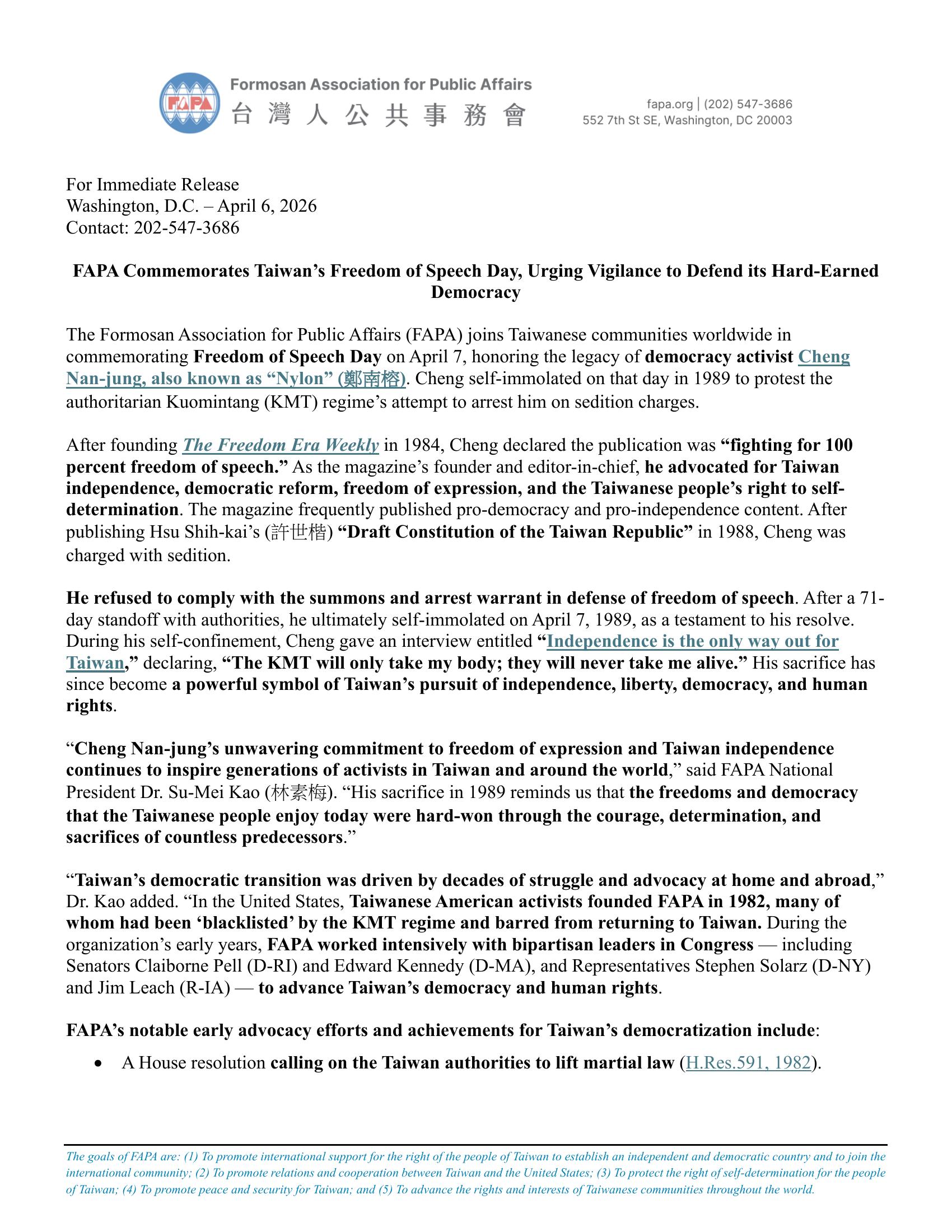
The Formosan Association for Public Affairs (FAPA) joins Taiwanese communities worldwide in commemorating Freedom of Speech Day on April 7, honoring the legacy of democracy activist Cheng Nan-jung, also known as “Nylon” (鄭南榕). Cheng self-immolated on that day in 1989 to protest the authoritarian Kuomintang (KMT) regime’s attempt to arrest him on sedition charges.
After founding The Freedom Era Weekly in 1984, Cheng declared the publication was “fighting for 100 percent freedom of speech.” As the magazine’s founder and editor-in-chief, he advocated for Taiwan independence, democratic reform, freedom of expression, and the Taiwanese people’s right to self-determination. The magazine frequently published pro-democracy and pro-independence content. After publishing Hsu Shih-kai’s (許世楷) “Draft Constitution of the Taiwan Republic” in 1988, Cheng was charged with sedition.
He refused to comply with the summons and arrest warrant in defense of freedom of speech. After a 71-day standoff with authorities, he ultimately self-immolated on April 7, 1989, as a testament to his resolve. During his self-confinement, Cheng gave an interview entitled “Independence is the only way out for Taiwan,” declaring, “The KMT will only take my body; they will never take me alive.” His sacrifice has since become a powerful symbol of Taiwan’s pursuit of independence, liberty, democracy, and human rights.
“Cheng Nan-jung’s unwavering commitment to freedom of expression and Taiwan independence continues to inspire generations of activists in Taiwan and around the world,” said FAPA National President Dr. Su-Mei Kao (林素梅). “His sacrifice in 1989 reminds us that the freedoms and democracy that the Taiwanese people enjoy today were hard-won through the courage, determination, and sacrifices of countless predecessors.”
“Taiwan’s democratic transition was driven by decades of struggle and advocacy at home and abroad,” Dr. Kao added. “In the United States, Taiwanese American activists founded FAPA in 1982, many of whom had been ‘blacklisted’ by the KMT regime and barred from returning to Taiwan. During the organization’s early years, FAPA worked intensively with bipartisan leaders in Congress — including Senators Claiborne Pell (D-RI) and Edward Kennedy (D-MA), and Representatives Stephen Solarz (D-NY) and Jim Leach (R-IA) — to advance Taiwan’s democracy and human rights.
FAPA’s notable early advocacy efforts and achievements for Taiwan’s democratization include:
- A House resolution calling on the Taiwan authorities to lift martial law (Res.591, 1982).
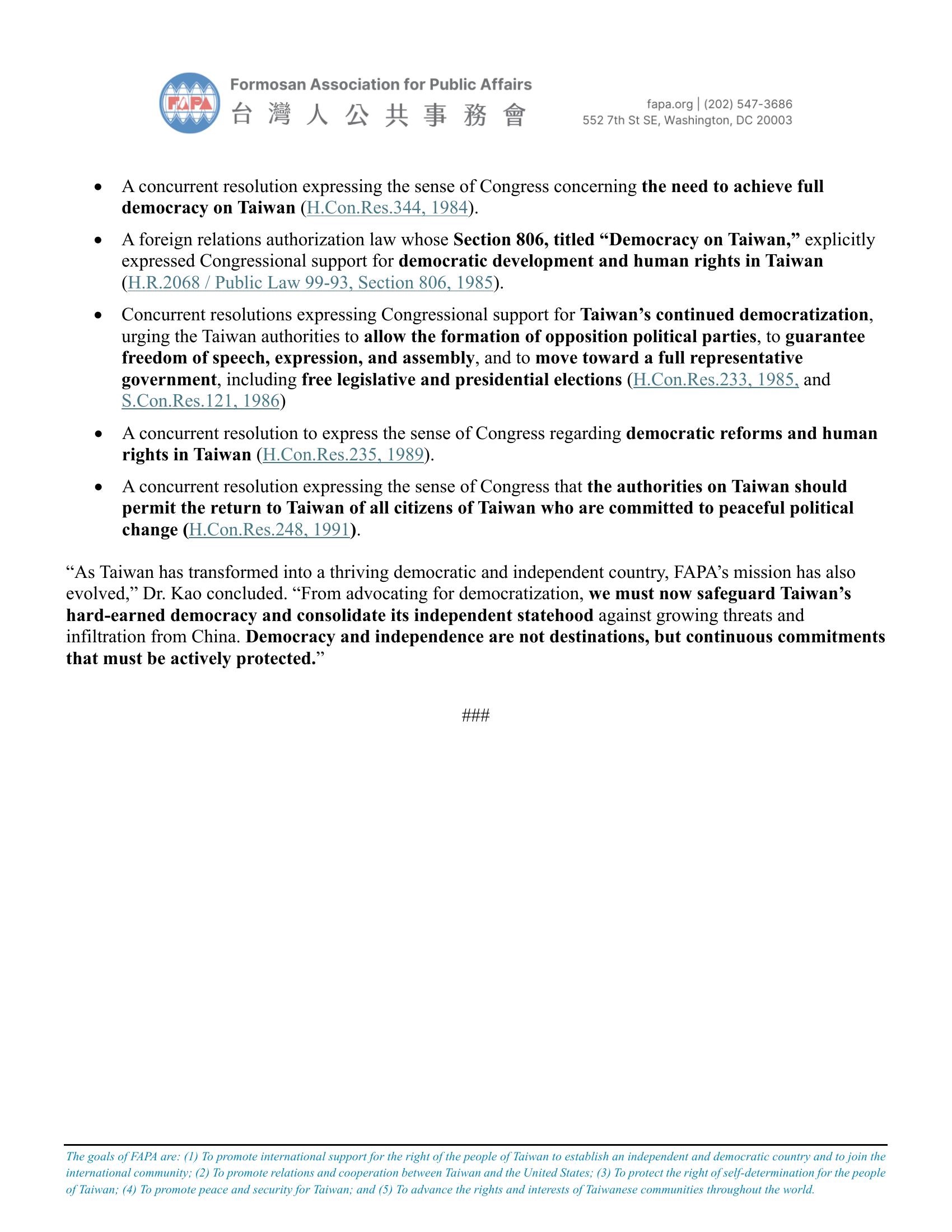
- A concurrent resolution expressing the sense of Congress concerning the need to achieve full democracy on Taiwan (Con.Res.344, 1984).
- A foreign relations authorization law whose Section 806, titled “Democracy on Taiwan,” explicitly expressed Congressional support for democratic development and human rights in Taiwan (R.2068 / Public Law 99-93, Section 806, 1985).
- Concurrent resolutions expressing Congressional support for Taiwan’s continued democratization, urging the Taiwan authorities to allow the formation of opposition political parties, to guarantee freedom of speech, expression, and assembly, and to move toward a full representative government, including free legislative and presidential elections (Con.Res.233, 1985, and S.Con.Res.121, 1986)
- A concurrent resolution to express the sense of Congress regarding democratic reforms and human rights in Taiwan (Con.Res.235, 1989).
- A concurrent resolution expressing the sense of Congress that the authorities on Taiwan should permit the return to Taiwan of all citizens of Taiwan who are committed to peaceful political change (Con.Res.248, 1991).
“As Taiwan has transformed into a thriving democratic and independent country, FAPA’s mission has also evolved,” Dr. Kao concluded. “From advocating for democratization, we must now safeguard Taiwan’s hard-earned democracy and consolidate its independent statehood against growing threats and infiltration from China. Democracy and independence are not destinations, but continuous commitments that must be actively protected.”
FAPA 紀念言論自由日:籲各界提高警覺,捍衛得來不易的台灣民主
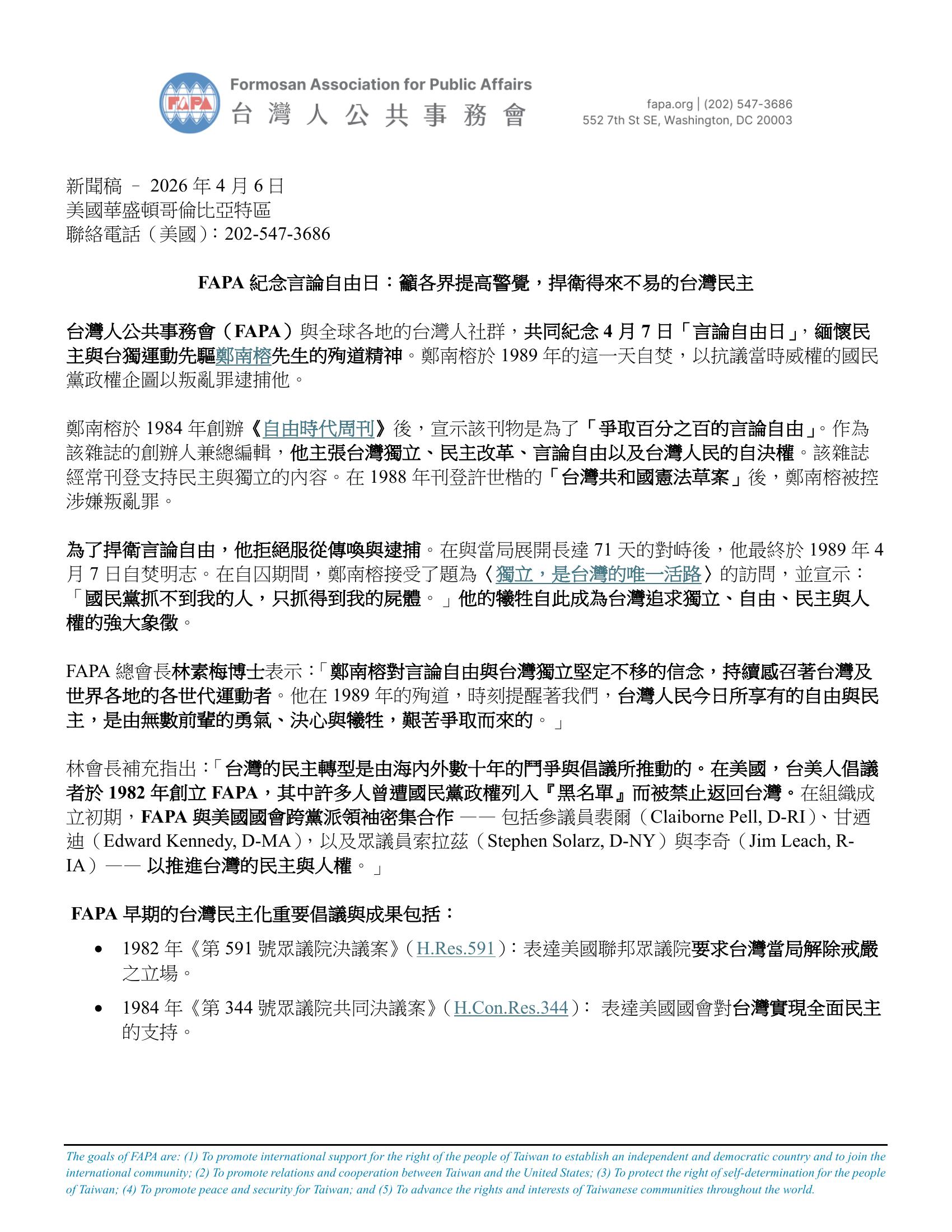
台灣人公共事務會(FAPA)與全球各地的台灣人社群,共同紀念 4 月 7 日「言論自由日」,緬懷民主與台獨運動先驅鄭南榕先生的殉道精神。鄭南榕於 1989 年的這一天自焚,以抗議當時威權的國民黨政權企圖以叛亂罪逮捕他。
鄭南榕於 1984 年創辦《自由時代周刊》後,宣示該刊物是為了「爭取百分之百的言論自由」。作為該雜誌的創辦人兼總編輯,他主張台灣獨立、民主改革、言論自由以及台灣人民的自決權。該雜誌經常刊登支持民主與獨立的內容。在 1988 年刊登許世楷的「台灣共和國憲法草案」後,鄭南榕被控涉嫌叛亂罪。
為了捍衛言論自由,他拒絕服從傳喚與逮捕。在與當局展開長達 71 天的對峙後,他最終於 1989 年 4 月 7 日自焚明志。在自囚期間,鄭南榕接受了題為〈獨立,是台灣的唯一活路〉的訪問,並宣示:「國民黨抓不到我的人,只抓得到我的屍體。」他的犧牲自此成為台灣追求獨立、自由、民主與人權的強大象徵。
FAPA 總會長林素梅博士表示:「鄭南榕對言論自由與台灣獨立堅定不移的信念,持續感召著台灣及世界各地的各世代運動者。他在 1989 年的殉道,時刻提醒著我們,台灣人民今日所享有的自由與民主,是由無數前輩的勇氣、決心與犧牲,艱苦爭取而來的。」
林會長補充指出:「台灣的民主轉型是由海內外數十年的鬥爭與倡議所推動的。在美國,台美人倡議者於 1982 年創立 FAPA,其中許多人曾遭國民黨政權列入『黑名單』而被禁止返回台灣。在組織成立初期,FAPA 與美國國會跨黨派領袖密集合作 —— 包括參議員裴爾(Claiborne Pell, D-RI)、甘迺迪(Edward Kennedy, D-MA),以及眾議員索拉茲(Stephen Solarz, D-NY)與李奇(Jim Leach, R-IA)—— 以推進台灣的民主與人權。」
FAPA 早期的台灣民主化重要倡議與成果包括:
- 1982 年《第 591 號眾議院決議案》(Res.591):表達美國聯邦眾議院要求台灣當局解除戒嚴之立場。
- 1984 年《第 344 號眾議院共同決議案》(Con.Res.344): 表達美國國會對台灣實現全面民主的支持。
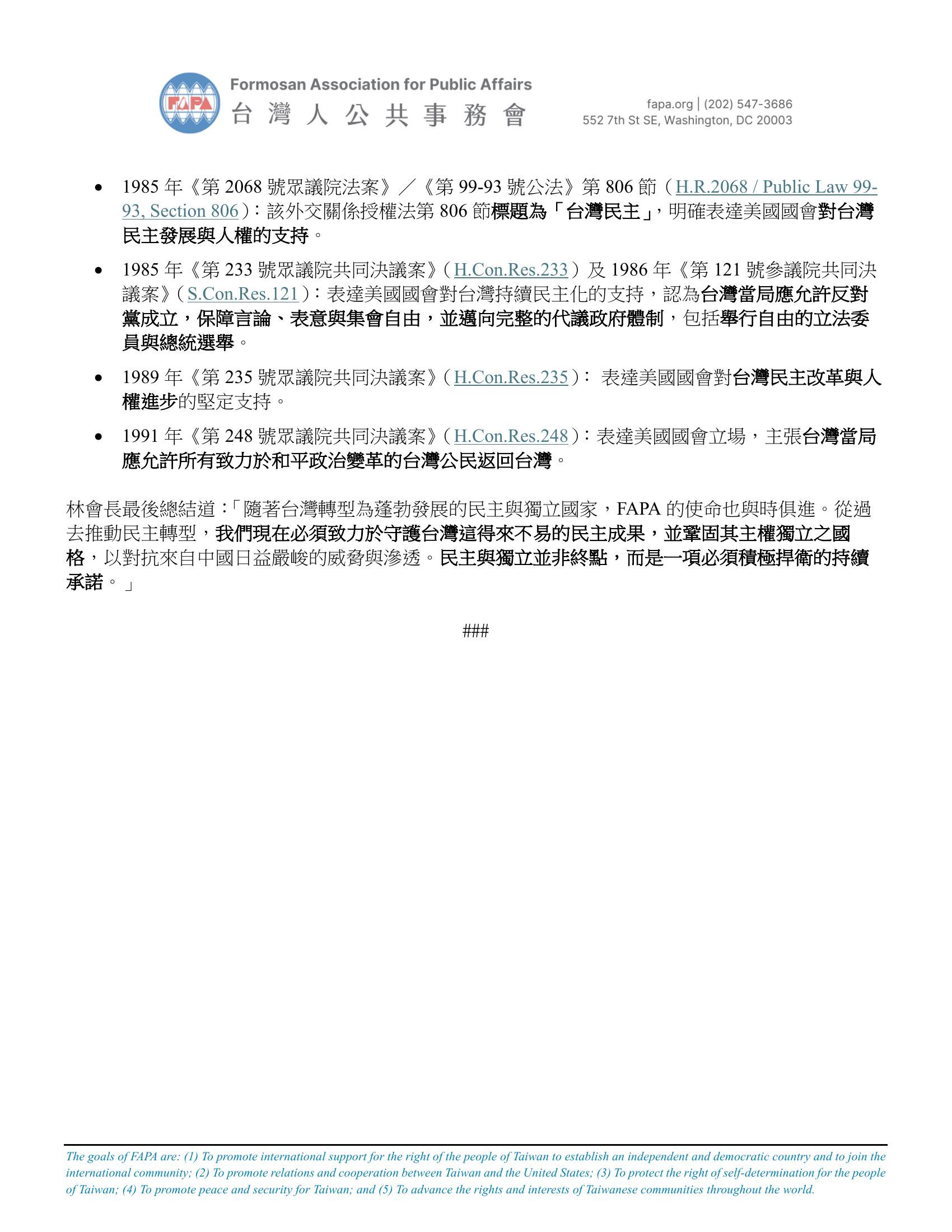
- 1985 年《第 2068 號眾議院法案》/《第 99-93 號公法》第 806 節(R.2068 / Public Law 99-93, Section 806):該外交關係授權法第 806 節標題為「台灣民主」,明確表達美國國會對台灣民主發展與人權的支持。
- 1985 年《第 233 號眾議院共同決議案》(Con.Res.233)及1986 年《第 121 號參議院共同決議案》(S.Con.Res.121):表達美國國會對台灣持續民主化的支持,認為台灣當局應允許反對黨成立,保障言論、表意與集會自由,並邁向完整的代議政府體制,包括舉行自由的立法委員與總統選舉。
- 1989 年《第 235 號眾議院共同決議案》(Con.Res.235): 表達美國國會對台灣民主改革與人權進步的堅定支持。
- 1991 年《第 248 號眾議院共同決議案》(Con.Res.248):表達美國國會立場,主張台灣當局應允許所有致力於和平政治變革的台灣公民返回台灣。
林會長最後總結道:「隨著台灣轉型為蓬勃發展的民主與獨立國家,FAPA 的使命也與時俱進。從過去推動民主轉型,我們現在必須致力於守護台灣這得來不易的民主成果,並鞏固其主權獨立之國格,以對抗來自中國日益嚴峻的威脅與滲透。民主與獨立並非終點,而是一項必須積極捍衛的持續承諾。」
###